
Reviewed · TOURS
Makars Mushroom Farm Summerhall Tour with DIY Block Making
Mushrooms, made simple, underground. The Makars Mushroom Farm Summerhall tour shows how Lion’s Mane mushrooms are grown in a sterile basement setup, and you get to make a DIY block you can take home. My two favorite parts are the hands-on inoculation session and seeing the fruiting tents where they actually monitor the crop. The one drawback to think about is that it’s in an underground basement, so it’s not a great fit if you feel claustrophobic, and there’s no accessible access.
This is an easy 1-hour visit with a small group (max 8) and an English-speaking guide. You’ll learn the full workflow, from grain production to incubation and fruiting, and you’ll finish with a time-lapse look at the fruiting process. For about $13, you’re not just watching from the sidelines, you’re leaving with a block to follow at home over the next few weeks.
It also helps that the tone is friendly and approachable, not overly technical. You can be a total mushroom newbie and still have fun, because the guide breaks things down into what matters and why. Just remember this is indoors, below ground, and built around practical growing techniques.
In This Review
- Key takeaways before you go
- Summerhall’s underground mushroom lab in Edinburgh: what to expect in the room
- The meeting point inside Summerhall
- Lion’s Mane growth, step by step: grain to incubation to fruiting
- 1) Grain production
- 2) Incubation in sterile conditions
- 3) Fruiting: where the mushrooms show up
- Fruiting tents and crop monitoring: the lesson isn’t just what, it’s why
- What to look for before harvest
- The time-lapse fruiting effect
- Make your own inoculated block: the hands-on session you’ll remember
- Why this matters for your future enjoyment
- A playful, human touch
- Price and value at about $13: what you’re really paying for
- Who this tour suits best (and who should skip it)
- Best fit
- Considerations
- Should you book Makars Mushroom Farm at Summerhall?
- FAQ
- How long is the Makars Mushroom Farm Summerhall tour?
- What do I get to take home?
- Is the tour only for mushroom experts?
- Where is the meeting point at Summerhall?
- Is it suitable for wheelchair users or young children?
- How can I get there from public transport, and is parking available?
- Can I cancel, and do I need to pay immediately?
Key takeaways before you go
- Underground grow lab: Expect a disused basement space at Summerhall, not a bright, airy garden.
- Lion’s Mane focus: You’ll learn the steps from grain production to incubation and fruiting.
- See the fruiting tents: You’ll understand how oxygen, water, and nutrients affect the crop.
- Inoculate your own block: You take something home that can fruit in about three weeks.
- Small-group feel: Limited to 8 participants, so it’s less “lecture,” more guided Q&A.
- Playful, human guide energy: The tour blends science with a warm, hands-on vibe.
Still mapping out your days in Edinburgh? These are the tours our team rated highest.
- Edinburgh: Loch Ness, Glencoe & the Scottish Highlands Tour★ 4.6 · 17,446 reviews
- Edinburgh: Harry Potter Magical Guided Walking Tour★ 4.8 · 11,944 reviews
- Edinburgh: Underground Vaults Tour★ 4.6 · 11,758 reviews
- Edinburgh Castle: Guided Walking Tour with Entry Ticket★ 4.7 · 11,699 reviews
Summerhall’s underground mushroom lab in Edinburgh: what to expect in the room
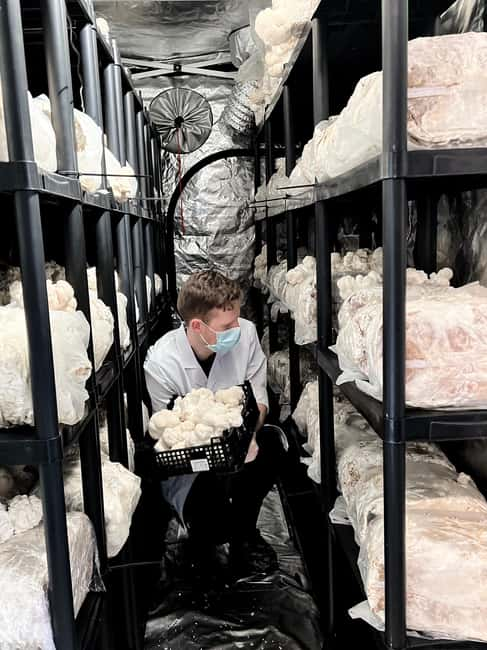
Makars Mushroom Farm runs tours out of a disused underground basement inside Summerhall, an arts venue in Edinburgh. That location choice is part of the point. Mushrooms don’t grow well on vibes. They grow well in controlled conditions, and the space helps you understand why sterility is such a big deal.
The tour lasts about 1 hour and keeps group sizes small, capped at 8 people. That matters because the guided mushroom growing process includes practical moments. With a smaller group, you’re more likely to ask questions, get direct answers, and actually see what’s going on up close rather than from a distance.
Getting there is also pretty straightforward once you know the terrain. Summerhall is walkable through the Meadows, and you can bring a bike (either inside or locked in racks). Public buses serve the area, including routes 3, 5, 7, 8, 29, 31, 47, and 49 stopping on South Clerk Street, plus routes 42 and 67 stopping directly outside the main entrance. Parking exists but is limited to street meter options, so you’ll want to allow extra time.
The meeting point inside Summerhall
Go into the main entrance, then walk to the back door where the stairs are. Go down the stairs and follow signs for the machine room. Turn left and follow signs to the end of the corridor. It’s not complicated, but it’s easy to miss if you’re rushing, so arrive a touch early and follow the signs.
Lion’s Mane growth, step by step: grain to incubation to fruiting
The tour’s heart is a clear explanation of how Lion’s Mane mushrooms are grown reliably. You start with the basics: fungi are a third major branch in evolution, and they have food potential that sits somewhere between the plant world and the meat world. It’s a fun framing, because it makes the science feel relevant rather than abstract.
Then the guide moves into the real workflow you’ll be shown in the space.
1) Grain production
You’ll learn how grain is used as a starting point. The key idea here is that the foundation matters. If your starting material isn’t set up correctly, you can end up with poor results later. The tour keeps this practical, focusing on why each stage exists instead of piling on complicated terminology.
2) Incubation in sterile conditions
Next comes incubation: the period where the mycelium is established before fruiting begins. This is where the tour really earns its keep. You’ll see the logic behind sterile technique, and you’ll understand why the environment is kept clean enough to support the mushroom you want, not random contaminants.
You don’t need a biology degree to follow this part. The guide explains what they’re trying to prevent and what they’re trying to encourage.
3) Fruiting: where the mushrooms show up
Once incubation is complete, the process shifts to fruiting. This is where you get to see the setup that supports growth through to harvest. The tour’s explanation makes clear that fruiting isn’t just “wait and see.” It’s managing conditions so the crop forms correctly.
Fruiting tents and crop monitoring: the lesson isn’t just what, it’s why
One of the most interesting parts of the experience is that you don’t only look at equipment. You also learn what to monitor while the mushrooms are forming.
In the fruiting tents, the guide talks about factors like oxygen, water, and nutrients. Those three details sound simple, but in mushroom cultivation they’re the difference between a crop that develops well and a crop that stalls or looks wrong. The tour helps you connect the dots between what you can measure or influence and what you’ll eventually see on the mushrooms.
What to look for before harvest
You’ll also hear what to look for when assessing the mushroom crop before harvest. Even if you don’t know the names of everything, you’ll come away with the basic “grower’s eye”: you’ll know that timing and condition cues matter. That’s a big reason this feels more educational than a quick walk-through.
The time-lapse fruiting effect
To wrap up the learning side, you’ll watch timelapse videos of the fruiting process. It’s a smart touch, because mushrooms don’t always change on a schedule that matches how humans want to experience progress. The time-lapse makes the growth story feel clear and satisfying, like putting the invisible timeline into focus.
Make your own inoculated block: the hands-on session you’ll remember
The finale is what turns the tour from interesting to genuinely valuable: you inoculate your own mushroom block to take home. The idea is simple, but the execution is the point. The tour shows you how this step connects back to the earlier sterile environment work.
You’re not just leaving with a souvenir. You’re leaving with a living project you can watch over time. The block is designed to fruit in about three weeks, so you get a real-world reason to plan ahead and follow through.
Why this matters for your future enjoyment
A DIY block changes how you think about what you saw earlier. When you hear about sterility, incubation, and fruiting tents, it stops being “their process” and becomes “the process behind my own outcome.” That’s why people tend to remember this tour better than a typical museum-style attraction.
It’s also a nice way to get a low-pressure science hobby. You’ll learn enough to understand what’s happening without needing to build your own setup from scratch.
A playful, human touch
One more thing that makes the session feel special is the guide’s personality. The vibe can be friendly and a little playful, with small handmade mushroom extras that pop up for fun moments like seasonal celebrations. It’s not the science that makes it memorable, but it helps the whole experience feel warm and human.
Price and value at about $13: what you’re really paying for
At around $13 per person for a 1-hour guided tour, the value is strong because you’re getting three parts in one:
1) A guided look at a real cultivation workflow
2) Access to the sterile environment and fruiting tent setup
3) Your own inoculated block to take home
If the tour were only a show-and-tell, the price would be easier to question. But since you leave with a block (and not just information), the cost starts to make sense as a hands-on workshop piece. Plus, the small-group size matters. Limited to 8 people, you’re not fighting for attention.
You do have to treat it like an experience that’s about participation. If you hate interacting, ask a few questions, or touching things (within what’s allowed), the tour might feel more like a lecture. If you like learning by doing, it’s a great match.
Who this tour suits best (and who should skip it)
This is one of those activities that works across different interest levels. You don’t need to be a mushroom expert to enjoy it. The guide’s approach is practical and geared toward explaining the “why” behind each step, which helps beginners feel included without making it childish.
Best fit
You’ll likely love this if you:
- Want a fun, science-y activity in Edinburgh that’s still hands-on
- Are curious about Lion’s Mane and how cultivation works
- Enjoy small-group tours where questions are welcome
- Like the idea of taking home a project and checking results later
Considerations
- It’s underground in a basement, which may not work well for claustrophobia.
- There’s no accessible access for wheelchair users.
- Children under 10 aren’t suitable.
Should you book Makars Mushroom Farm at Summerhall?
I’d book it if you want a short, focused Edinburgh activity that gives you real insight into how mushrooms are grown and ends with something you can actually take home and watch. The combination of a sterile growing tour plus DIY inoculation is exactly what turns this into more than entertainment.
I wouldn’t book it if you strongly dislike underground spaces, or you need wheelchair accessibility. If you’re okay with a basement setting and you’re ready for a hands-on session, it’s a smart-value way to spend an hour and come away with a living reason to keep thinking about what you learned.
FAQ
How long is the Makars Mushroom Farm Summerhall tour?
The tour is 1 hour long.
What do I get to take home?
You inoculate your own mushroom block to take home, and it’s set up to fruit in about three weeks.
Is the tour only for mushroom experts?
No. The tour is suitable for all interest levels, not just mushroom enthusiasts.
Where is the meeting point at Summerhall?
Go into the main entrance, walk to the back door where the stairs are, go down the stairs, and follow signs for the machine room. Turn left and follow signs to the end of the corridor.
Is it suitable for wheelchair users or young children?
It’s not suitable for wheelchair users due to lack of accessible access. Children under 10 years are not suitable.
How can I get there from public transport, and is parking available?
Summerhall is walkable through the Meadows, and buses serve the venue. Routes 42 and 67 stop directly outside the main entrance, while routes 3, 5, 7, 8, 29, 31, 47, and 49 stop on South Clerk Street for a short walk. Street meter parking is limited.
Can I cancel, and do I need to pay immediately?
Free cancellation is available up to 24 hours in advance for a full refund. You can also reserve now and pay later, with no payment required today.
More Tours in Edinburgh
- Edinburgh: Loch Ness, Glencoe & the Scottish Highlands Tour★ 4.6 · 17,446 reviews
- Edinburgh: Harry Potter Magical Guided Walking Tour★ 4.8 · 11,944 reviews
- Edinburgh: Underground Vaults Tour★ 4.6 · 11,758 reviews
- Edinburgh Castle: Guided Walking Tour with Entry Ticket★ 4.7 · 11,699 reviews
- From Edinburgh: Loch Ness, Glencoe & Scottish Highlands Tour★ 4.7 · 11,381 reviews
More Tour Reviews in Edinburgh
- Edinburgh: Loch Ness, Glencoe & the Scottish Highlands Tour★ 4.6 · 17,446 reviews
- Edinburgh: Harry Potter Magical Guided Walking Tour★ 4.8 · 11,944 reviews
- Edinburgh: Underground Vaults Tour★ 4.6 · 11,758 reviews
- Edinburgh Castle: Guided Walking Tour with Entry Ticket★ 4.7 · 11,699 reviews
- From Edinburgh: Loch Ness, Glencoe & Scottish Highlands Tour★ 4.7 · 11,381 reviews
Fresh off the cobbles: newer Edinburgh tours we have written up





Tours, compared.
 ★ 4.6Loch Ness, Glencoe & the Scottish Highlands TourFrom $6217,446 reviews
 ★ 4.8Harry Potter Magical Guided Walking TourFrom $1911,944 reviews
 ★ 4.6Underground Vaults TourFrom $3211,758 reviews
 ★ 4.7Edinburgh Castle: Guided Walking Tour with Entry TicketFrom $4911,699 reviews
 ★ 4.7Loch Ness, Glencoe & Scottish Highlands TourFrom $6111,381 reviews
 ★ 4.8Edinburgh Castle Guided History Tour with TicketsFrom $499,933 reviews
 ★ 4.5The World Famous Underground Ghost TourFrom $269,272 reviews
 ★ 4.5Underground Vaults Walking Tour in Edinburgh Old TownFrom $338,506 reviews